
STATE OF CONFUSION

In the last chapter, we learned about the concept of game of percentage in WTT and WTB support and resistance on LTP Calculator. In this chapter, we are going to learn the concept of state of confusion in support and resistance on LTP Calculator. Let’s start learning.
Lesson Highlights
State of Confusion
When support or resistance is weak either towards the top (WTT) or towards the bottom (WTB), and this condition persists for more than one hour with certain conditions, it results in a State of Confusion.

State of confusion arises only in conditions of weak support and resistance, i.e., in WTT or WTB scenarios. State of Confusion or SOC can never occur in strong support and resistance. For a WTT or WTB to qualify as a state of confusion, at least one hour must have passed since the weakness was identified, along with the fulfilment of certain conditions.
State of Confusion in Support
State of confusion in support always makes the market bearish. How does this happen, and what are the conditions that create this state of confusion in support? Let’s understand this.
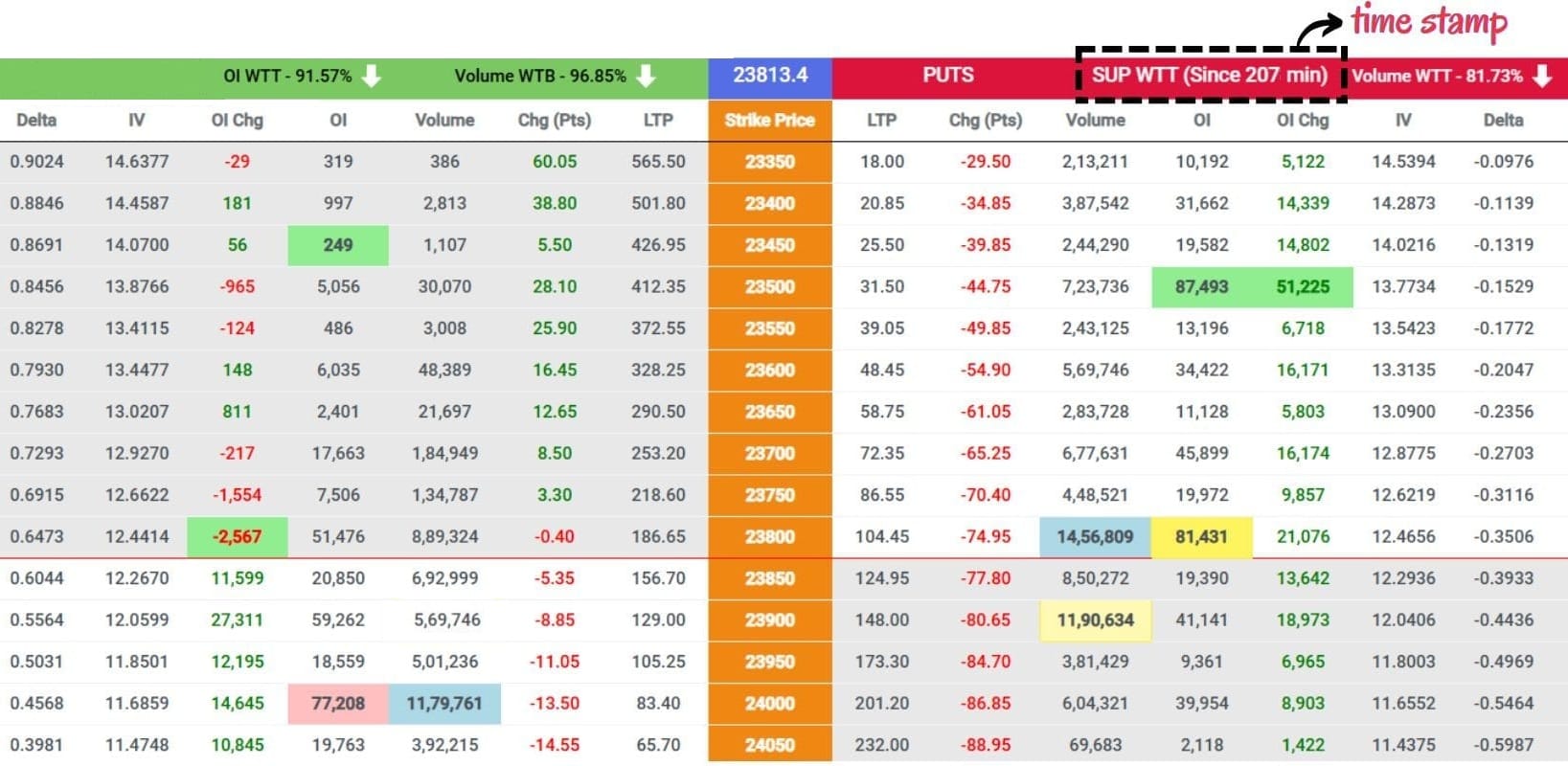
Look at the above image. Support is at 23800 and it is WTT at 23900. This is a bullish scenario. At the top of the image, there is the time stamp that indicates the time that has been passed from when the support identified as WTT. Now, understand the conditions that will create the state of confusion and make this bullish scenario to bearish.
Condition 1: One Hour SOC
If the support is WTT or WTB and its percentage remains stable (stable means fluctuating between 2% to 5%) for more than one hour, and the resistance is strong, then it creates a SOC in support.
Condition 2: Two Hour SOC
If the support is WTT or WTB, and its percentage keeps fluctuating between 10% and 15% (but support does not shift) for two hours, and the resistance is strong, then it creates a SOC in support.
Condition 3: Three Hour SOC
If the support has been shifted from the top to bottom, or from bottom to top and in that continuation, it appears as WTT or WTB. If the percentage of this WTT or WTB either becomes stable or keeps fluctuating (indicating that the newly formed support has not become strong) for more than three hours, and the resistance is strong, then it creates a SOC in support.
Please Note:
In all three conditions of State of Confusion – one hour, two hour, or three hour, the time is to be counted from the moment the shifting process begins, i.e., from when the support becomes WTT or WTB.
In the case of a state of confusion in support, the resistance must be strong for the market to fall. If the resistance is also WTT or WTB, the market will not fall.
Now, you know everything about when the market will fall. But the important thing is: from where the market will start falling and what will be the bottom of the market. In the state of confusion, the market will fall from the extension of resistance, and the bottom of the market will be the diversion of the strike until which there is confusion. For example: in the above image, support is confused between 23900 and 23800 then market will fall till the diversion of 23800 i.e. smallest strike price diversion.
Conclusion: Top is EOR and Bottom is the diversion of smallest strike price in SOC.
State of Confusion in Resistance
State of confusion in resistance always makes the market bullish. How does this happen, and what are the conditions that create this state of confusion in resistance? Let’s understand this.
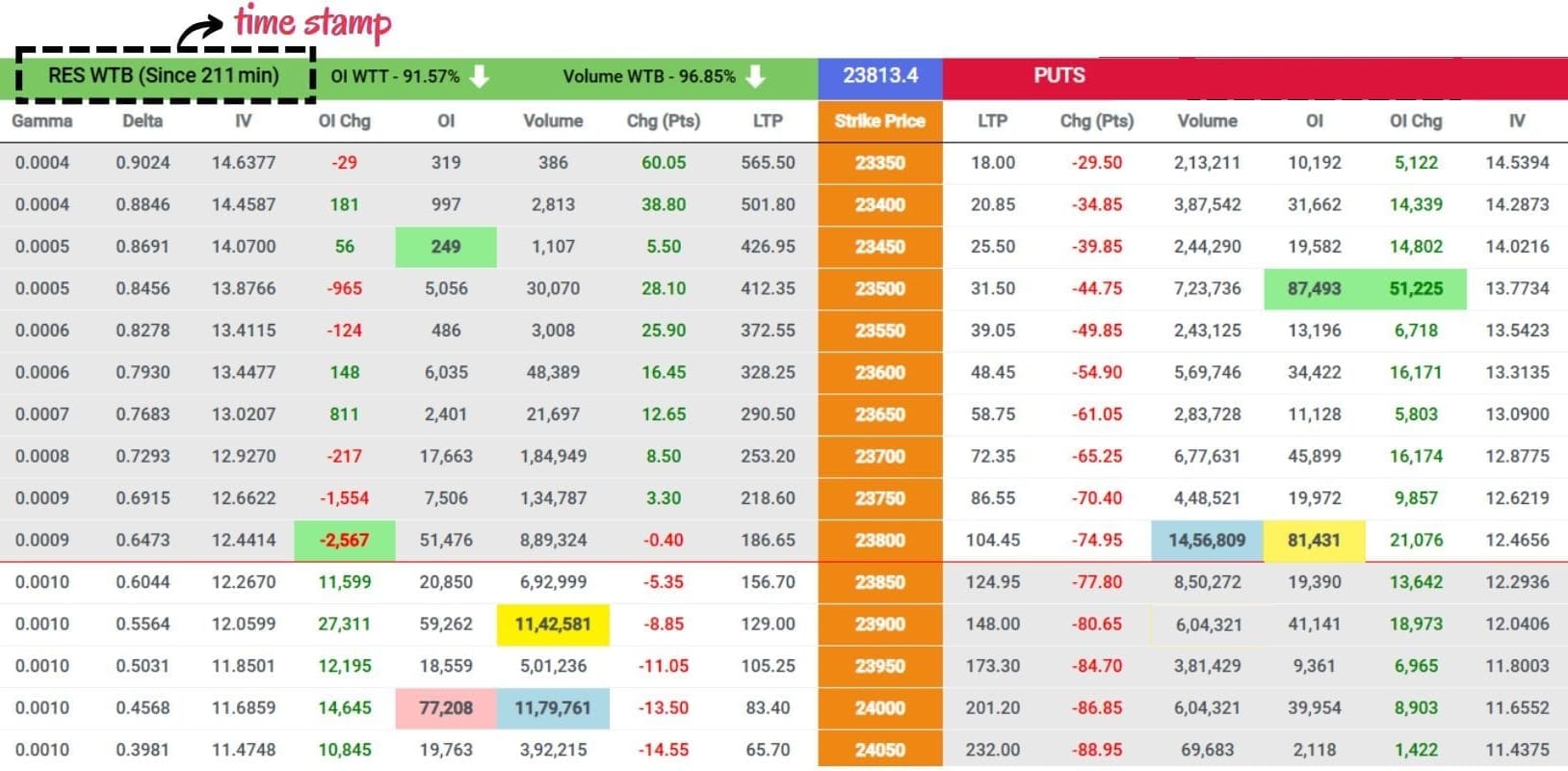
Look at the above image. Resistance is at 24000 and it is WTB at 23900. This is a bearish scenario. At the top of the image, there is the time stamp that indicates the time that has been passed from when the resistance identified as WTB. Now, understand the conditions that will create the state of confusion and make this bearish scenario to bullish.
Condition 1: One Hour SOC
If the resistance is WTT or WTB and its percentage remains stable (stable means fluctuating between 2% to 5%) for more than one hour, and the support is strong, then it creates a SOC in resistance.
Condition 2: Two Hour SOC
If the resistance is WTT or WTB, and its percentage keeps fluctuating between 10% and 15% (but resistance does not shift) for two hours, and the support is strong, then it creates a SOC in resistance.
Condition 3: Three Hour SOC
If the resistance has been shifted from the top to bottom, or from bottom to top and in that continuation, it appears as WTT or WTB. If the percentage of this WTT or WTB either becomes stable or keeps fluctuating (indicating that the newly formed resistance has not become strong) for more than three hours, and the support is strong, then it creates a SOC in resistance.
Please Note:
In all three conditions of State of Confusion – one hour, two hour, or three hour, the time is to be counted from the moment the shifting process begins, i.e., from when the support becomes WTT or WTB.
In the case of a state of confusion in resistance, the support must be strong for the market to fly. If the support is also WTT or WTB, the market will not fly.
Now, you know everything about when the market will fly. But the important thing is: from where the market will become bullish and what will be the top of the market. In the state of confusion, the market will fly from the extension of support, and the top of the market will be the diversion of the strike until which there is confusion. For example: in the above image, resistance is confused between 23900 and 24000 then market will be bullish till the diversion of 24000 i.e. largest strike price diversion.
Conclusion: Bottom is EOS and Top is the diversion of largest strike price in SOC.
Conclusion
In this chapter of the LTP Calculator free course, we learned the concept of the state of confusion in support and resistance on the LTP Calculator. My motive with this chapter was to teach you the scenarios in which the market moves against the chart of accuracy 1.0. The game of percentage and the time passed from when the support or resistance identified as WTT and WTB play a key role in the state of confusion.
So, keep learning the stock market with LTP Calculator, and believe me, one day you’ll also say, It’s a Baccho ka Khel.